From smart grid operators in the UAE and Gulf region to automation engineers managing distributed SCADA systems across multiple continents, the demand for precise, reliable time synchronization has never been more critical. Yet despite its foundational role in industrial infrastructure, time synchronization equipment is often selected without a clear framework — leaving networks exposed to accuracy drift, compliance gaps, and cascade failures that are difficult to diagnose after the fact. This guide walks through every parameter that matters when specifying an NTP time server for industrial use.
Why Precise Time Synchronization Matters in Industrial Networks
Modern industrial networks are built on the assumption that every node shares a common, accurate time reference. PLCs, RTUs, protection relays, data historians, and network switches all generate timestamped events. When those timestamps are inconsistent — even by tens of milliseconds — the integrity of the entire data record is compromised.
Network time protocol industrial implementations are not simply about keeping clocks tidy. Precise time is a functional requirement for event sequencing, fault analysis, regulatory reporting, and in some industries, transaction validity.
Consequences of Poor Time Synchronization in SCADA and Telecom
In SCADA environments, timestamp errors corrupt the sequence of events (SOE) logs that engineers rely on during post-incident analysis. If two protection relays record conflicting timestamps around a fault event, it becomes impossible to determine which tripped first — and why. Root cause analysis fails. Regulatory reporting becomes unreliable.
In telecom networks, timing errors affect synchronization of base stations, packet transport networks, and billing systems. In financial trading platforms, unsynchronized clocks can invalidate trade records and trigger regulatory penalties under MiFID II and similar frameworks. The consequences of poor time synchronization scale with the criticality of the network it affects.
Key Parameters to Evaluate When Choosing an NTP Server
Signal Source: GPS, GLONASS or Both
The signal source is the most fundamental specification of any Stratum 1 NTP server. GPS time synchronization remains the global standard, providing sub-microsecond accuracy referenced to atomic clocks maintained by the US Naval Observatory. However, in regions where GPS signal availability may be affected by urban canyon effects, jamming, or geopolitical considerations, relying on a single constellation introduces risk.
GPS and GLONASS NTP time servers that support multi-constellation reception — combining GPS with GLONASS, Galileo, or BeiDou — provide significantly higher resilience. If one constellation is temporarily unavailable or degraded, the server continues to operate at full accuracy from the remaining sources. For critical infrastructure, multi-constellation support is not a luxury — it is the correct baseline specification.
Stratum Level and Accuracy
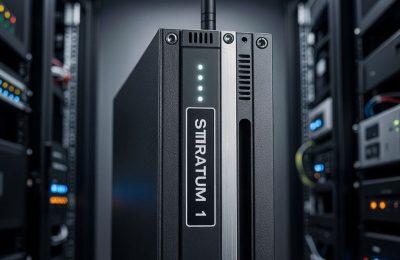
The stratum hierarchy defines how many hops a device is away from the primary reference source. A Stratum 0 device is the atomic clock or GNSS receiver itself. A Stratum 1 NTP server is directly connected to a Stratum 0 source and distributes time to the network. Stratum 2 servers synchronize from Stratum 1, and so on.
For industrial networks, Stratum 1 is the correct target. Stratum 1 exact time servers deliver accuracy in the range of ±100 nanoseconds to ±1 microsecond relative to UTC — sufficient for SCADA, protection relay coordination, and most telecom applications. Deploying a Stratum 2 or higher device as the primary reference in a critical network is a common and avoidable mistake.
Protocol Support: NTP, PTP IEEE 1588, SNMP
Not all industrial environments require only NTP. A well-specified exact time server should support multiple protocols simultaneously. NTP (Network Time Protocol) handles general-purpose time distribution across IT and OT networks with millisecond-level accuracy. PTP IEEE 1588 (Precision Time Protocol) extends accuracy to sub-microsecond levels and is required for applications such as protection relay coordination in power grids and 5G fronthaul timing.
SNMP support enables integration into existing network management systems, allowing the time server’s operational status, signal lock, and drift metrics to be monitored alongside other network infrastructure. Verify that the device you specify supports SNMPv2c or SNMPv3 depending on your security policy.
Redundancy and Failover Options
A single point of failure in time synchronization infrastructure is unacceptable in mission-critical networks. Industrial-grade NTP servers should support redundant power supply inputs, dual network interfaces, and holdover capability — the ability to maintain accurate time output from an internal oscillator when the GNSS signal is lost.
Holdover performance varies significantly between devices. Entry-level units may drift by several milliseconds per hour during GNSS outage. High-stability units equipped with OCXO (Oven-Controlled Crystal Oscillator) or Rubidium oscillators can maintain accuracy within microseconds for hours or even days. Match the holdover specification to the realistic GNSS outage risk in your deployment environment.
Form Factor: Rack-Mount vs DIN-Rail
Industrial time synchronization equipment is available in two primary form factors, and the choice depends entirely on where the device will be installed. Rack-mount units (1U or 2U) are designed for IT server rooms, telecom equipment rooms, and data center environments. They integrate naturally into existing rack infrastructure and typically offer more interface options and higher port density.
DIN-rail mount units are designed for industrial cabinets, substations, and control panels where rack infrastructure is absent. They operate across wider temperature ranges, often carry higher ingress protection ratings, and are built to industrial EMC standards. Deploying a rack-mount unit in a substation environment — or a DIN-rail unit in a data center — creates unnecessary integration complexity and potential compliance issues.
NTP vs PTP: Which Protocol Do You Need
When NTP Is Sufficient
NTP delivers accuracy in the range of 1–10 milliseconds over a well-managed network, dropping to sub-millisecond performance on local area networks with proper configuration. This is sufficient for the majority of industrial applications: data historians, HMI systems, general-purpose SCADA polling, IT/OT network logging, and building management systems. NTP clocks for industrial facilities covering these use cases are mature, cost-effective, and straightforward to integrate.
If your most demanding requirement is consistent event timestamping across a distributed SCADA system, NTP from a Stratum 1 GPS clock for industry is almost certainly adequate.
When You Need PTP IEEE 1588
PTP is required when sub-microsecond accuracy is non-negotiable. Specific applications include: differential protection in electrical power systems (where relay coordination windows can be as narrow as 1 microsecond), 5G network fronthaul and midhaul timing, precision motion control in manufacturing, and high-frequency financial trading infrastructure. PTP requires PTP-aware network switches throughout the synchronization path — a significant infrastructure consideration that must be evaluated before specifying PTP as the solution.
Industries That Require Industrial-Grade NTP Servers

Telecommunications
Telecom networks operate on timing hierarchies defined by ITU-T standards (G.811, G.8272, G.8273). Base stations, packet transport nodes, and core network elements all require traceable timing derived from a primary reference clock. Time synchronization devices for telecom networks must support SyncE (Synchronous Ethernet) and PTP profiles defined for telecom applications, in addition to standard NTP output for legacy equipment.
Energy and Power Grids
Protection relays, phasor measurement units (PMUs), and digital fault recorders in power grid infrastructure require time accuracy of 1 microsecond or better for correct operation. IEC 61850 substations depend on precise timestamping for GOOSE messaging and sampled values. A GPS clock for industry deployed at the substation level, distributing time via IRIG-B or PTP to field devices, is standard practice in modern grid automation.
Financial Trading Platforms
Regulatory frameworks in the EU, US, and increasingly across the Middle East require financial institutions to timestamp trade records with traceable, auditable accuracy. MiFID II mandates synchronization to within 100 microseconds of UTC for high-frequency trading systems. An NTP server UAE-based financial institutions deploy must demonstrate GNSS-traceable accuracy and maintain audit logs of synchronization performance.
Industrial Automation and SCADA
Time synchronization for SCADA is required for meaningful sequence-of-events logging, historian data integrity, and coordinated control across distributed sites. In oil and gas, mining, water treatment, and manufacturing environments, the NTP server for industrial network deployment must operate reliably across wide temperature ranges, handle industrial EMC environments, and integrate with both legacy serial and modern Ethernet-based control systems.
Checklist: How to Choose the Right NTP Server for Your Network

Before issuing a specification or RFQ, confirm answers to the following:
- Signal source: Single-constellation GPS or multi-constellation (GPS + GLONASS / Galileo)?
- Required accuracy:> Millisecond (NTP sufficient) or sub-microsecond (PTP required)?
- Stratum level: Is Stratum 1 required, or is Stratum 2 from an upstream server acceptable?
- Protocol support: NTP only, or NTP + PTP + IRIG-B + SyncE?
- Redundancy: Dual power supply, dual NIC, holdover oscillator grade (TCXO / OCXO / Rubidium)?
- Holdover requirement: How long must the server maintain accuracy during GNSS outage?
- Form factor: Rack-mount (IT/telecom room) or DIN-rail (substation/industrial cabinet)?
- Operating temperature: Standard (0–50°C) or extended industrial range (−40°C to +70°C)?
- Management: SNMP monitoring required? Web UI? CLI?
- Certifications: CE, EAC, or other regional approvals required for your market?
JCOM IoT Time Synchronization Equipment
JCOM IoT develops and supplies a full range of industrial time synchronization equipment — from compact DIN-rail NTP servers for substation and control panel installation to high-availability rack-mount GLONASS NTP server units with redundant power and OCXO holdover for telecom and data center environments. All devices support multi-constellation GNSS input and simultaneous NTP and PTP IEEE 1588 output, with SNMP integration and extended industrial temperature ratings where required.
Our engineering team works with clients across energy, telecom, industrial automation, and financial infrastructure to specify the correct device for each deployment — accounting for environment, accuracy requirements, redundancy needs, and regional certification requirements.
Ready to specify the right solution for your network? Request a quote for NTP time server and our engineers will respond with a tailored recommendation within one business day.